Buyers spec the finish on a rigid box down to the last detail — the foil, the soft-touch lamination, the ribbon color — and then leave the single most important decision to the factory: how thick the board is. That one number does more to determine how a box feels in the hand, how well it protects, and what it costs to make and ship than any surface treatment. A gorgeous soft-touch wrap over thin, floppy board still feels cheap the moment someone picks it up. This is a look under the wrap at the board itself: what it is, how thickness and grammage relate, how much you actually need, and how the covering paper fits into the picture.
The board is the box; everything else is decoration
A rigid box — the “setup box” in the trade — is built from a stiff paperboard core that is cut, cornered, and then wrapped in a separate printed or specialty paper. The rigidity, the reassuring weight, the way a lid settles down onto a base and the dent resistance that keeps corners sharp all come from that core, not from the wrap. The core is almost always grey chipboard, usually just called greyboard: a dense, recycled fiber board prized for stiffness and a low price per ton. Alternatives exist — kraft-faced chipboard, duplex board — but grey chipboard is the default for luxury rigid boxes because it holds an edge and a shape better than lighter, cheaper stocks. Understand the board and you understand ninety percent of what makes one rigid box feel more expensive than another.
Thickness and grammage are the same spec in two languages
Board is described two ways, and confusing them is where a lot of ordering errors start. Thickness is a physical measurement in millimeters (sometimes points, where one point is a thousandth of an inch). Grammage is weight per area in grams per square meter, or gsm. For greyboard the two track each other almost linearly: thickness in millimeters is roughly grammage times 1.55 and divided by 1,000, which works out to about 1.55 millimeters of board for every 1,000 gsm. So a 1.5 mm board lands near 970 gsm, a 2.0 mm board near 1,290 gsm, and a 3.0 mm board near 1,935 gsm. The chart below plots that relationship, with the band where most rigid boxes actually live.
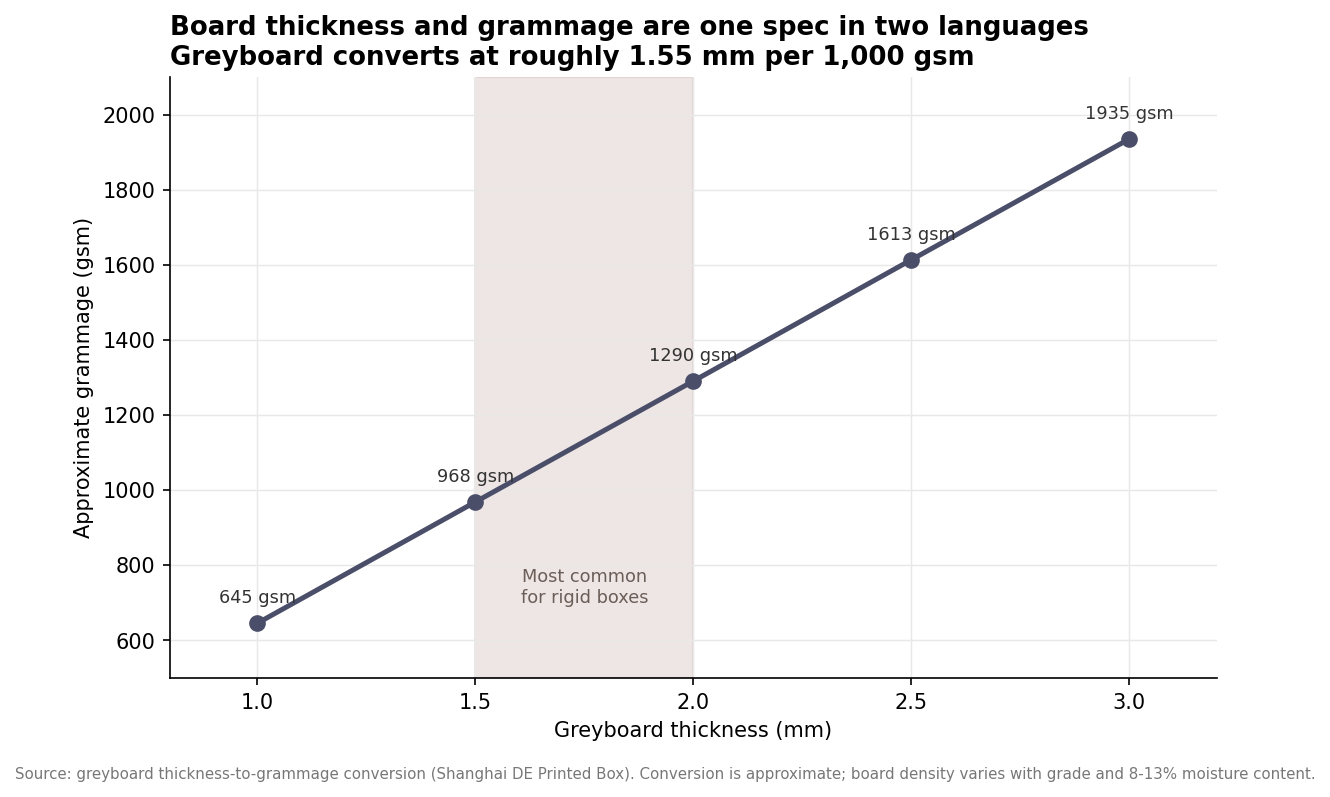
Two cautions on that conversion. First, it is approximate — greyboard density varies by grade and with moisture content, which sits around 8 to 13 percent and changes stiffness, so two boards at the same nominal gsm can feel slightly different. Second, know which language your supplier speaks. Asian factories often quote gsm, while a US or European buyer may think in millimeters or points. State both if you can, and you remove the ambiguity entirely.
How thick is thick enough for your product
The commonly used range for rigid boxes is 1.5 mm to 2 mm, and most projects should start there. From that baseline, move up or down based on what goes inside. Light products — jewelry, cosmetics, small accessories — are well served by 1.2 to 1.5 mm, where the box needs to feel solid but is not carrying much weight or absorbing drops. Mid-weight apparel and accessories sit comfortably at 1.5 to 2.0 mm. Heavier or higher-value goods — electronics, spirits, gift sets that will be handled and shipped — justify 2.0 to 3.0 mm, where the extra board buys real corner and dent resistance. The chart below maps those starting points by product type.
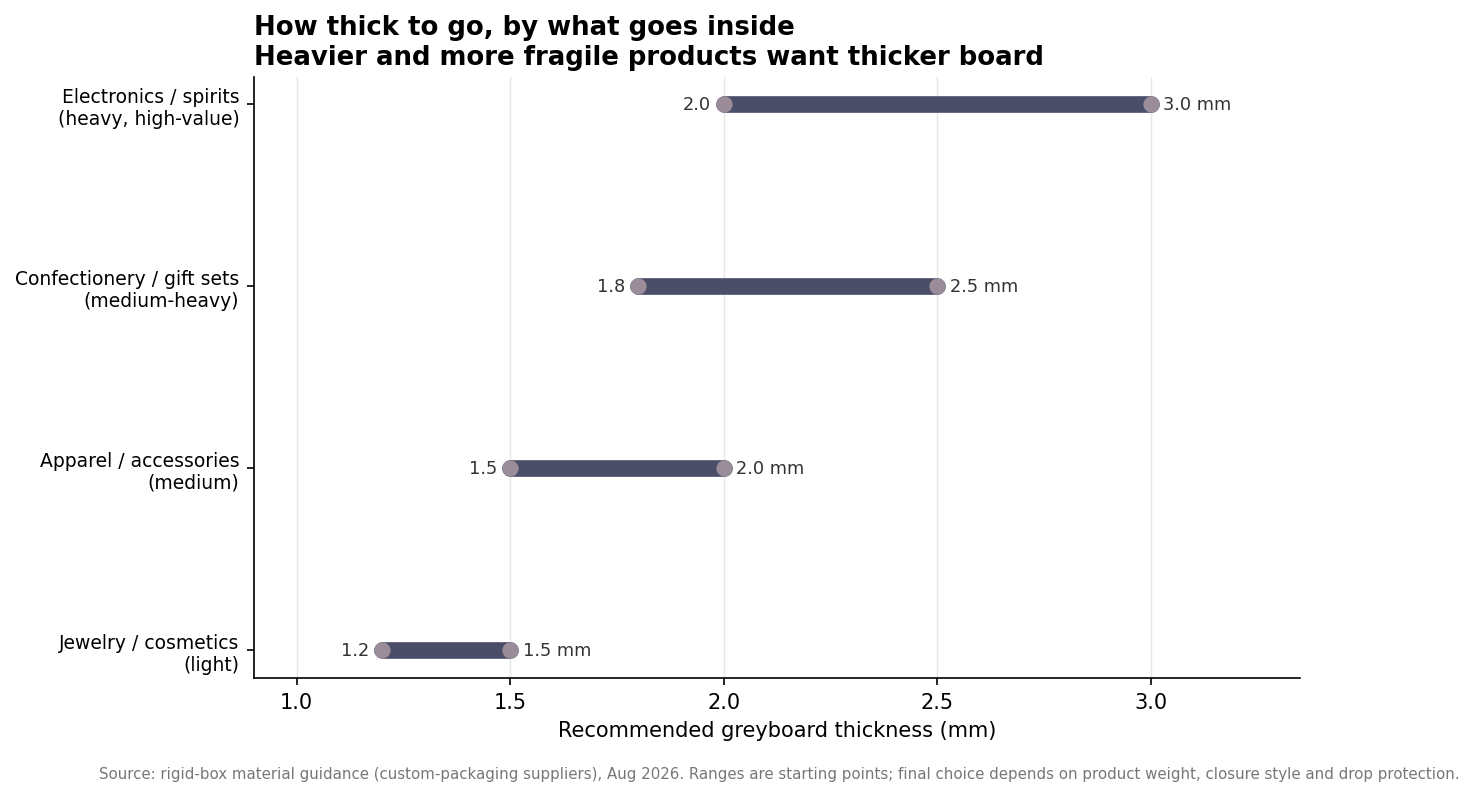
Thicker is not free, and it is not automatically better. Heavier board improves stiffness and impact resistance but adds weight, which raises both material cost and shipping cost on every unit — and greyboard is priced by the ton, roughly in the range of a few hundred dollars for ordinary grades up to around a thousand for premium Grade A stock, so the board line moves with thickness across a large run. Over-speccing a lightweight product in 3 mm board wastes money on both ends. The goal is the thinnest board that still delivers the feel and protection the product needs, not the thickest you can buy.
The wrap changes the feel more than you would guess
Once the board is set, the covering paper does the visual and tactile work. Common wrap materials include coated art paper, which is the everyday choice and typically a lightweight sheet in the neighborhood of 120 to 160 gsm; textured and specialty papers; kraft; metallic stocks; and premium coverings like fabric, linen, and leatherette for a distinctly non-paper hand. The wrap adds almost no rigidity, so it cannot rescue thin board — but it changes perception dramatically. A wrap that is too thin will telegraph the board seams and the glued edges underneath, especially over dark board, which is why very light wraps are often paired with a liner or a heavier sheet. Textured and uncoated specialty papers also hide fingerprints far better than high-gloss coated stock, a real consideration for a box customers will pick up and turn over.
Speccing the board without guessing
Put four things on the specification and you remove almost all the risk. State the board thickness in millimeters, and add the gsm if your maker quotes that way. Name the grade — grey chipboard for luxury work — rather than leaving it to whatever is cheapest that week. Specify the wrap material and its weight separately from the board, since they are two different decisions. And ask for a plain, unwrapped sample of the exact board so you can feel the corner strength and flex before the full run. One more detail worth confirming: telescoping and magnetic-closure styles sometimes use different board on the lid than the base, so ask whether the quoted thickness applies to the whole box or just one part. Get the board right and every finish you add sits on a foundation that already feels expensive; get it wrong and no amount of foil will fix it.
Leave a Reply