Category: Uncategorized

  • How Thick Should a Rigid Box Be? Greyboard, Grammage, and Wrap, Explained

    How Thick Should a Rigid Box Be? Greyboard, Grammage, and Wrap, Explained

    Buyers spec the finish on a rigid box down to the last detail — the foil, the soft-touch lamination, the ribbon color — and then leave the single most important decision to the factory: how thick the board is. That one number does more to determine how a box feels in the hand, how well it protects, and what it costs to make and ship than any surface treatment. A gorgeous soft-touch wrap over thin, floppy board still feels cheap the moment someone picks it up. This is a look under the wrap at the board itself: what it is, how thickness and grammage relate, how much you actually need, and how the covering paper fits into the picture.

    The board is the box; everything else is decoration

    A rigid box — the “setup box” in the trade — is built from a stiff paperboard core that is cut, cornered, and then wrapped in a separate printed or specialty paper. The rigidity, the reassuring weight, the way a lid settles down onto a base and the dent resistance that keeps corners sharp all come from that core, not from the wrap. The core is almost always grey chipboard, usually just called greyboard: a dense, recycled fiber board prized for stiffness and a low price per ton. Alternatives exist — kraft-faced chipboard, duplex board — but grey chipboard is the default for luxury rigid boxes because it holds an edge and a shape better than lighter, cheaper stocks. Understand the board and you understand ninety percent of what makes one rigid box feel more expensive than another.

    Thickness and grammage are the same spec in two languages

    Board is described two ways, and confusing them is where a lot of ordering errors start. Thickness is a physical measurement in millimeters (sometimes points, where one point is a thousandth of an inch). Grammage is weight per area in grams per square meter, or gsm. For greyboard the two track each other almost linearly: thickness in millimeters is roughly grammage times 1.55 and divided by 1,000, which works out to about 1.55 millimeters of board for every 1,000 gsm. So a 1.5 mm board lands near 970 gsm, a 2.0 mm board near 1,290 gsm, and a 3.0 mm board near 1,935 gsm. The chart below plots that relationship, with the band where most rigid boxes actually live.
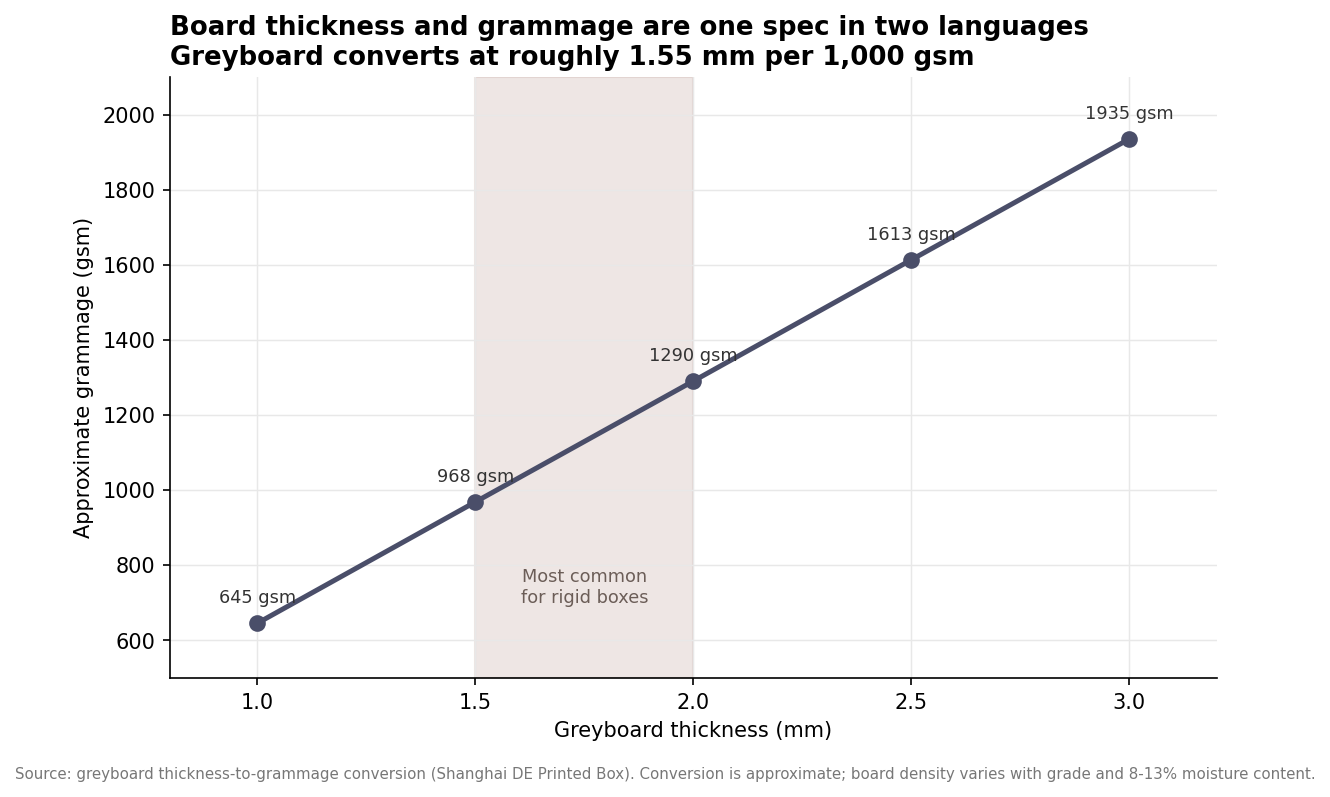
    Line chart showing greyboard thickness in millimeters converting to grammage in gsm at roughly 1.55 mm per 1000 gsm, with the 1.5 to 2.0 mm common band highlighted
    Greyboard thickness and grammage track almost linearly; most rigid boxes use 1.5 to 2.0 mm board.

    Two cautions on that conversion. First, it is approximate — greyboard density varies by grade and with moisture content, which sits around 8 to 13 percent and changes stiffness, so two boards at the same nominal gsm can feel slightly different. Second, know which language your supplier speaks. Asian factories often quote gsm, while a US or European buyer may think in millimeters or points. State both if you can, and you remove the ambiguity entirely.

    How thick is thick enough for your product

    The commonly used range for rigid boxes is 1.5 mm to 2 mm, and most projects should start there. From that baseline, move up or down based on what goes inside. Light products — jewelry, cosmetics, small accessories — are well served by 1.2 to 1.5 mm, where the box needs to feel solid but is not carrying much weight or absorbing drops. Mid-weight apparel and accessories sit comfortably at 1.5 to 2.0 mm. Heavier or higher-value goods — electronics, spirits, gift sets that will be handled and shipped — justify 2.0 to 3.0 mm, where the extra board buys real corner and dent resistance. The chart below maps those starting points by product type.
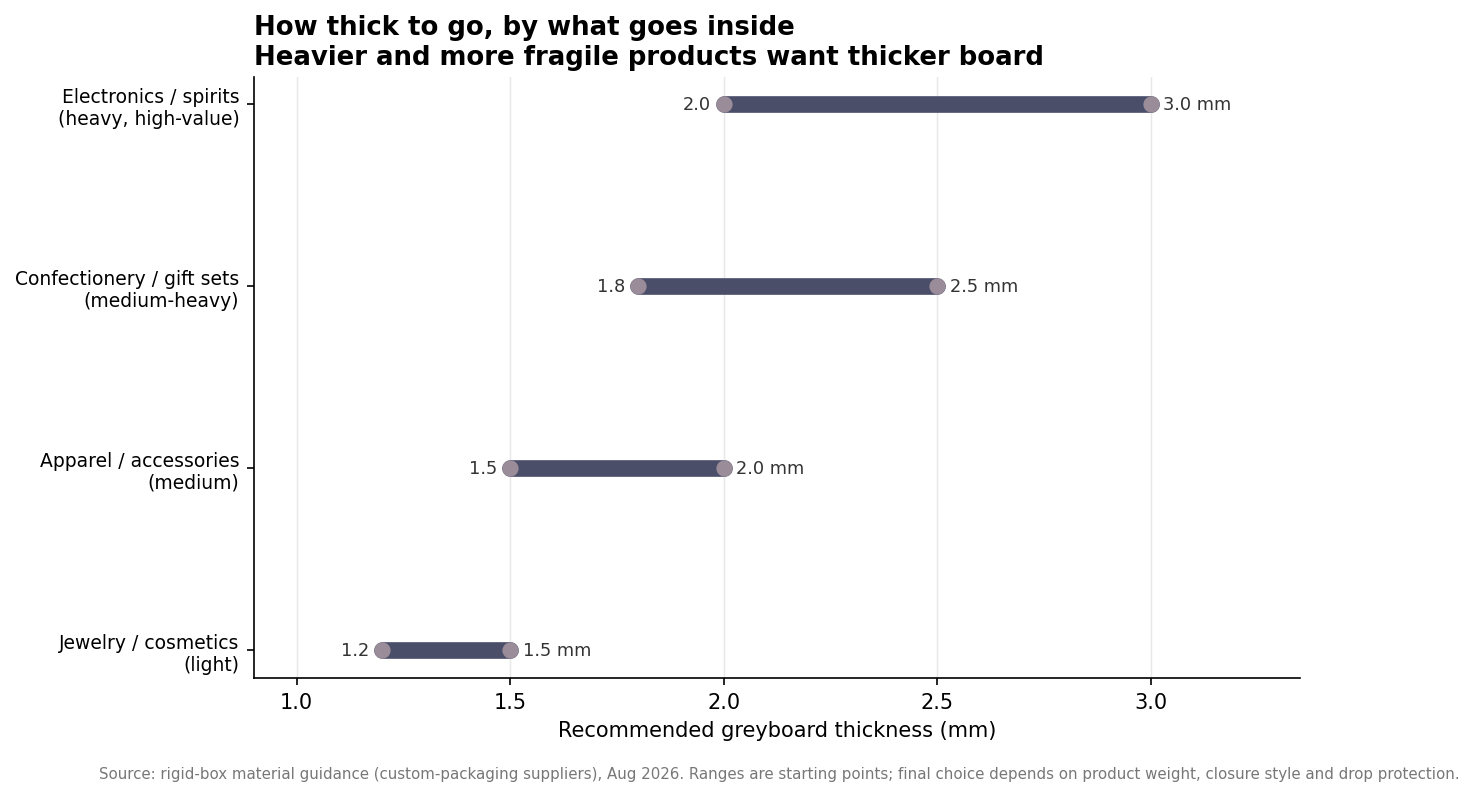
    Horizontal range chart of recommended greyboard thickness in millimeters by product type, from light jewelry to heavy electronics and spirits
    Recommended starting thickness by product type; heavier and more fragile goods justify thicker board.

    Thicker is not free, and it is not automatically better. Heavier board improves stiffness and impact resistance but adds weight, which raises both material cost and shipping cost on every unit — and greyboard is priced by the ton, roughly in the range of a few hundred dollars for ordinary grades up to around a thousand for premium Grade A stock, so the board line moves with thickness across a large run. Over-speccing a lightweight product in 3 mm board wastes money on both ends. The goal is the thinnest board that still delivers the feel and protection the product needs, not the thickest you can buy.

    The wrap changes the feel more than you would guess

    Once the board is set, the covering paper does the visual and tactile work. Common wrap materials include coated art paper, which is the everyday choice and typically a lightweight sheet in the neighborhood of 120 to 160 gsm; textured and specialty papers; kraft; metallic stocks; and premium coverings like fabric, linen, and leatherette for a distinctly non-paper hand. The wrap adds almost no rigidity, so it cannot rescue thin board — but it changes perception dramatically. A wrap that is too thin will telegraph the board seams and the glued edges underneath, especially over dark board, which is why very light wraps are often paired with a liner or a heavier sheet. Textured and uncoated specialty papers also hide fingerprints far better than high-gloss coated stock, a real consideration for a box customers will pick up and turn over.

    Speccing the board without guessing

    Put four things on the specification and you remove almost all the risk. State the board thickness in millimeters, and add the gsm if your maker quotes that way. Name the grade — grey chipboard for luxury work — rather than leaving it to whatever is cheapest that week. Specify the wrap material and its weight separately from the board, since they are two different decisions. And ask for a plain, unwrapped sample of the exact board so you can feel the corner strength and flex before the full run. One more detail worth confirming: telescoping and magnetic-closure styles sometimes use different board on the lid than the base, so ask whether the quoted thickness applies to the whole box or just one part. Get the board right and every finish you add sits on a foundation that already feels expensive; get it wrong and no amount of foil will fix it.
  • Collapsible Magnetic Rigid Boxes: How Fold-Flat Construction Cuts Your Shipping Bill

    Collapsible Magnetic Rigid Boxes: How Fold-Flat Construction Cuts Your Shipping Bill

    A rigid box feels expensive because it is built to. Thick board, a wrapped finish, and a lid that closes with a satisfying snap all say “this matters.” The catch shows up on the freight invoice: a traditional set-up rigid box arrives fully assembled, which means you are largely paying to ship air. Custom magnetic closure rigid boxes that are engineered to fold flat, usually sold as collapsible rigid boxes, keep the premium feel while shipping and storing like a stack of paper. Understanding how they are made is the key to deciding whether the tradeoff is worth it for your product.

    Set-up versus collapsible: the same box, built to fold

    A standard rigid box is glued into its final three-dimensional shape at the factory and can never lie flat again. A collapsible rigid box is cut and creased so it can be pressed flat for transport and popped back into shape at the destination, typically holding itself together with hidden magnets. From the outside, a well-made collapsible box is nearly indistinguishable from a set-up box: same thick walls, same wrapped exterior, same weight in the hand. The difference is entirely in the engineering of the folds, and that engineering is what lets you fit several times as many boxes into the same carton or container.

    The V-groove hinge that makes it work

    The structural trick is a technique called V-grooving. A cutting machine scores a precise V-shaped channel into the greyboard, removing most of the board’s thickness, often 60 to 80 percent, and leaving only a thin layer, on the order of 0.3 millimeters, intact to act as a living hinge. A 90-degree groove produces a clean right-angle fold for a standard box; tighter angles are used for smaller boxes that need to fold more compactly. Because so much depends on that thin remaining layer, manufacturers control the board’s moisture content, commonly to a window around 8 to 12 percent, so the hinge folds crisply instead of cracking or going soft. Done well, those hinges survive many dozens of fold-and-unfold cycles, which is what makes a collapsible box reusable rather than a one-trip item.

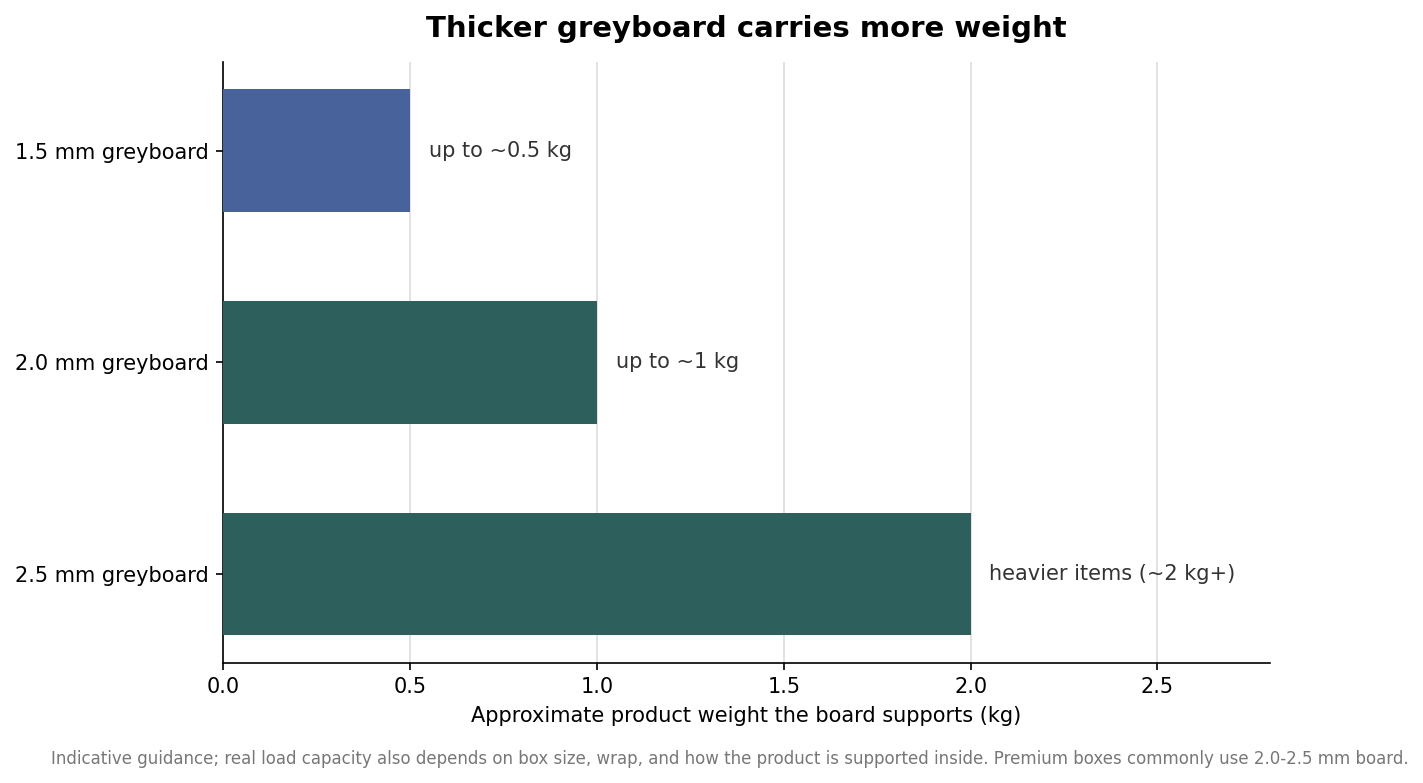
    Greyboard thickness still does the heavy lifting. Thicker board resists crushing and supports more weight, so the choice is driven by what goes inside. As a rough guide, thinner 1.5 millimeter board suits light products, 2.0 millimeter handles a wider range, and 2.5 millimeter and up is reserved for heavier items; premium boxes most often land in the 2.0 to 2.5 millimeter range.

    Horizontal bar chart mapping greyboard thickness to approximate product weight supported: 1.5 mm up to about 0.5 kg, 2.0 mm up to about 1 kg, 2.5 mm for heavier items
    Greyboard thickness scales with product weight; premium rigid boxes commonly use 2.0 to 2.5 mm board.

    Match the board to the product weight and the handling it will get. Underspec the board and the box feels flimsy and the hinges fatigue faster; overspec it and you pay for material and folding complexity you do not need. When in doubt, ask a supplier to recommend a thickness for your exact product weight and dimensions rather than guessing.

    What folding flat actually saves

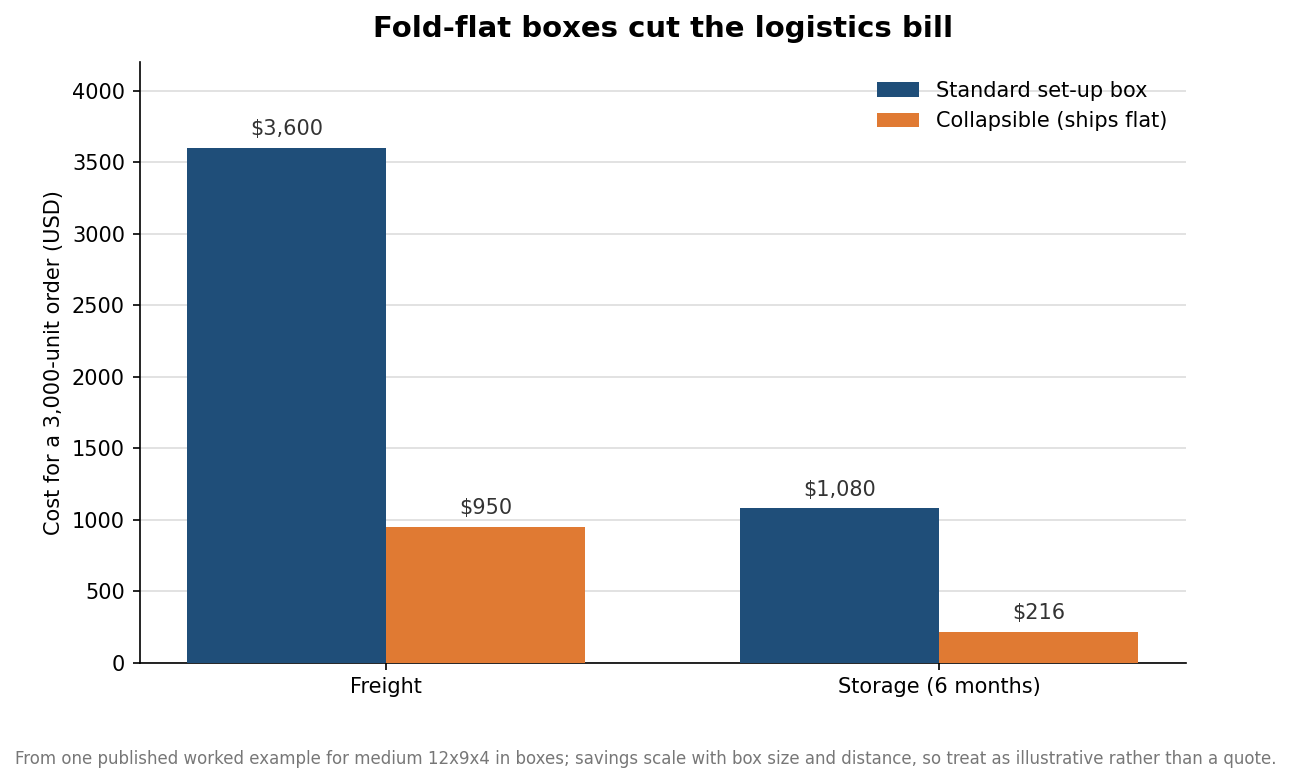
    The economics are the reason collapsible boxes exist. Because flat boxes stack densely, one commonly cited figure is fitting four to five times as many units into the same shipping container, which pushes freight costs down substantially and cuts the warehouse space you rent to hold inventory. A published worked example for a 3,000-unit order of medium boxes captures the shape of it: freight falling from roughly $3,600 to about $950, and six months of pallet storage dropping from around $1,080 to a little over $200, because the flat units needed a fraction of the pallets.

    Grouped bar chart comparing freight and six-month storage costs for a 3,000-unit order of standard set-up rigid boxes versus collapsible boxes that ship flat
    In one worked example, folding flat cut freight from $3,600 to $950 and storage from $1,080 to $216.

    Treat those numbers as illustrative rather than a quote, because the savings scale with how bulky your box is and how far it ships. A large, deep box that traps a lot of empty volume benefits enormously from folding flat; a small, shallow box that already stacks reasonably well benefits less. The honest way to evaluate it is to price the same design both ways, including freight and a realistic estimate of storage, and compare the totals rather than just the per-box production price.

    Where the magnet fits

    Magnets are what let a folded box snap into a rigid shape and stay closed without tape or tabs. Small neodymium disc magnets are the common choice because they are compact and strong, producing that crisp closing pull; softer ferrite magnets give a gentler close and are sometimes used where a subtle feel is wanted. The magnets are set into routed cavities in the board and sealed under the interior lining, so they are completely hidden and cannot be felt through the wrap. Placement along the mating edges of the lid and body is what aligns the box as it closes. For collapsible designs, the same magnets often do double duty, holding the walls square once the box is erected.

    When collapsible is worth it, and when it is not

    Collapsible construction is not free. The V-groove cutting and added magnets typically raise the unit production cost by roughly 10 to 15 percent over a plain set-up box, and because the tooling is more involved, minimum order quantities commonly sit in the 500 to 1,000 unit range per design. There is also a small labor cost on your end, since someone has to pop each box into shape, on the order of 15 to 20 seconds per unit by hand, unless you build that into a pack-out line. In the worked example above, the higher production cost was more than offset by freight and storage savings, landing the collapsible option a bit cheaper per box overall, but that math depends entirely on box size and volume.

    The practical decision rule is straightforward. If you ship large or deep rigid boxes, hold meaningful inventory, or move product across long distances, folding flat usually pays for itself and the magnetic closure is a genuine upgrade in feel. If your boxes are small, your quantities tiny, or your customers assemble nothing themselves and you cannot spare pack-out labor, a traditional set-up box may still be the simpler call. Either way, ask for a physical sample of the exact board and magnet before committing, because the difference between a collapsible box that feels premium and one that feels cheap comes down to details you can only judge in the hand.

    Fold-flat magnetic rigid boxes are one of the few packaging upgrades that can improve both the unboxing moment and the logistics line at once. Spec the board to your product, price the design with freight and storage included, and the choice between set-up and collapsible stops being a matter of taste and becomes a number you can actually compare.

  • How Many Custom Rigid Boxes Should You Order?

    Call or Text us: (929) 605-4397
    ection class=”section section–cream”>

    Home › Blog › How Many Custom Rigid Boxes Should You Order?

    Ordering

    How Many Custom Rigid Boxes Should You Order?

    07/01/2026

    Ordering custom rigid boxes for the first time, most brands either overbuy on a design they’ll refine or underbuy and miss the price break — and both cost money. Because rigid boxes carry tooling and setup costs, the per-unit price drops sharply with volume, so order size is an economic decision as much as a usage one.

    Here’s how to size an order once you separate your program into its real use cases.

    Launch: order to a real tier, not the minimum

    For a product launch, the setup and tooling costs dominate at low volume — the per-box price at 100 can be several times the price at 1,000. If your design is final, ordering to a real tier slashes per-unit cost. If it might change, run a small sample or proof batch first, then scale.

    Retail rollout: base it on sell-through

    For retail, estimate weekly units, order 8–12 weeks of stock, and set a reorder trigger at about 3 weeks of cover. We keep your dieline and artwork on file, so reorders match exactly and move fast — no re-tooling.

    Subscription: order a full cycle plus growth

    For a subscription box, order a full cycle of your subscriber count plus expected growth, not month to month, to lock the volume price and avoid a stockout mid-cycle. Factor churn and new sign-ups into the number.

    ProgramStarting quantityWhy
    Launch (design final)Order to a real tier (often 1k+)Tooling/setup dominates at low volume
    Retail8–12 weeks of sell-throughReorder at ~3 weeks cover
    SubscriptionA full cycle + growthLocks price, avoids stockout
    Key takeaway

    Quantity is the biggest lever on per-box cost: once your design and dieline are set, ordering up one tier usually pays for itself.

    Tell us your product and volume and we’ll show you where the price tiers fall — with a free mockup, within one business day.

    More posts

    GET A QUOTE
  • A Guide to Rigid Box Styles: Which One Fits Your Product

    Call or Text us: (929) 605-4397
    ection class=”section section–cream”>

    Home › Blog › A Guide to Rigid Box Styles: Which One Fits Your Product

    Buyer Guides

    A Guide to Rigid Box Styles: Which One Fits Your Product

    06/17/2026

    Rigid boxes come in a handful of core constructions, and each creates a different unboxing and fits a different product and channel. Choosing the right style is the first and biggest packaging decision — it shapes cost, experience, and how the product is presented.

    Here’s a plain guide to the main rigid box styles and when to use each.

    Two-piece and tray-and-sleeve: versatile and efficient

    The two-piece lid-and-base box is the timeless, versatile default for retail and gifting. The tray-and-sleeve is its clean, modern, cost-efficient cousin, with a printed sleeve and a slide-out tray — great for sets and shelf products where you want premium presentation without the fully wrapped cost.

    Magnetic and book-style: the premium unboxing

    The magnetic-closure box delivers the signature soft-snap open that defines luxury unboxing, ideal for flagships and gift sets. The book-style box opens like a hardcover with a printable interior spread — the choice when you want the packaging to tell a story.

    Drawer and rigid mailer: keepable and shippable

    The drawer/slide box is tactile and keepable, perfect for jewelry and small sets. The rigid mailer is engineered to ship direct to consumers while keeping a premium feel — the format built for subscriptions and DTC.

    StyleBest forSignature
    Two-pieceRetail, giftingTimeless lift-off lid
    MagneticFlagships, setsSoft-snap unboxing
    DrawerJewelry, small setsSlide-out reveal
    Book-styleStorytelling launchesOpens like a book
    Rigid mailerSubscriptions, DTCShips premium
    Key takeaway

    Start from the channel: shipping direct favors the rigid mailer, retail favors two-piece or tray-and-sleeve, and a flagship reveal favors magnetic or book-style.

    Tell us your product and channel and we’ll recommend a style and mock it up — free, within one business day.

    More posts

    GET A QUOTE
  • Soft-Touch, Foil, and Emboss: Finishing a Rigid Box

    Call or Text us: (929) 605-4397
    ection class=”section section–cream”>

    Home › Blog › Soft-Touch, Foil, and Emboss: Finishing a Rigid Box

    Design & Artwork

    Soft-Touch, Foil, and Emboss: Finishing a Rigid Box

    06/03/2026

    Two rigid boxes of the same construction can feel worlds apart depending on their finish. The wrap, the decoration, and the tactile details are what separate a box that feels premium from one that just looks fine. Understanding the options lets you spend where it counts.

    Here’s how the main finishing choices change perceived value.

    The wrap sets the feel

    Soft-touch laminate is the single most-requested premium finish — a velvety hand-feel that instantly signals luxury. Matte reads modern and understated, gloss reads bold and vibrant, and specialty or cloth papers add texture. Because customers hold the box before they see the product, the wrap is doing first-impression work.

    Foil and emboss add richness

    Foil stamping presses a metallic (or blind) logo into the wrap that catches light and reads unmistakably high-end. Embossing and debossing add a tactile, dimensional mark. Layering a foil logo over a soft-touch wrap is one of the most reliable routes to a box that feels more expensive than it costs.

    Don’t forget the interior

    A printed or contrast-lined interior extends the experience past the lid — the reveal is where the customer’s attention peaks. A printed message, a contrast color, or a branded insert turns the open into a moment. Small interior touches deliver outsized impact on perceived value.

    Key takeaway

    If you spend on one upgrade, make it soft-touch laminate with a foil logo — it’s the combination that most reliably reads premium.

    Tell us your product and brand and we’ll mock up finish and decoration options side by side — free, within one business day.

    More posts

    GET A QUOTE
  • Designing Rigid Boxes for Subscription and DTC Brands

    Call or Text us: (929) 605-4397
    ection class=”section section–cream”>

    Home › Blog › Designing Rigid Boxes for Subscription and DTC Brands

    Subscription

    Designing Rigid Boxes for Subscription and DTC Brands

    05/20/2026

    For subscription and DTC brands, the box is the store. The mailbox is where the customer experiences the brand each month, and the unboxing is the moment that drives retention and referral. A rigid mailer that ships well and opens beautifully is one of the highest-leverage investments these brands can make.

    Here’s how to design rigid packaging for a subscription or DTC program.

    Engineer it to ship

    A subscription box has to survive the carrier, so use a reinforced rigid or rigid-hybrid mailer with a secure closure and a fitted cradle. The premium feel must be paired with real durability — a beautiful box that arrives dented does more harm than a plain one.

    Design the reveal

    The first thing a customer sees when the box opens should be your brand — a printed interior, a message, or a curated layout. This is the moment worth designing around, because it’s what customers photograph and share, turning each box into earned reach.

    Plan for repetition and cost

    Subscriptions reorder constantly, so design for a repeatable, cost-efficient production run and keep the dieline stable so reorders are fast and consistent. Small per-box savings compound across a year of shipments.

    Key takeaway

    For subscriptions, the unboxing isn’t a nicety — it’s the retention mechanism. Design the moment the box opens with the same care as the product inside.

    Tell us your subscriber count and product and we’ll design a shippable rigid box built for the unboxing — free mockup within one business day.

    More posts

    GET A QUOTE
  • Custom Rigid Boxes for Corporate Gifting

    Call or Text us: (929) 605-4397
    ection class=”section section–cream”>

    Home › Blog › Custom Rigid Boxes for Corporate Gifting

    Corporate

    Custom Rigid Boxes for Corporate Gifting

    05/06/2026

    A corporate gift is a brand impression in physical form, and the box carries most of the message. A thoughtful product in a premium rigid box reads as considered and generous; the same product in a flimsy box undercuts the gesture. Getting the packaging right is what makes a corporate gift land.

    Here’s how to build a corporate gift box that impresses tastefully.

    Match the box to the tier

    Use a magnetic or book-style box for top clients and executives, a two-piece box for broader client gifting, and a tray-and-sleeve for wider staff sends where budget matters. You can run several styles in one order and hit a single volume price.

    Keep the branding tasteful

    Corporate gifting works best when the branding is confident but restrained — a foil-stamped logo, a debossed mark, or a printed interior message, not a box shouting your name. The recipient should feel gifted, not marketed to.

    Design the whole gift

    The best corporate gift boxes present a curated set — a product, a card, maybe a consumable — in a fitted insert so it opens as a considered whole. A custom insert that cradles each element is what turns a box of items into a gift.

    Key takeaway

    The highest-return corporate gift is a mid-tier product in a genuinely premium box: the packaging is what the recipient sees first and remembers longest.

    Tell us your recipient tiers and gift contents and we’ll design a box and insert per tier — free mockups within one business day.

    More posts

    GET A QUOTE
  • Rigid Boxes vs. Folding Cartons: When to Use Which

    Call or Text us: (929) 605-4397
    ection class=”section section–cream”>

    Home › Blog › Rigid Boxes vs. Folding Cartons: When to Use Which

    Buyer Guides

    Rigid Boxes vs. Folding Cartons: When to Use Which

    04/22/2026

    Two packaging families dominate retail: rigid boxes and folding cartons. They look similar in a rendering but feel completely different in the hand and cost very differently to produce. Choosing between them is a core decision that shapes both your margins and your brand impression.

    Here’s how rigid boxes and folding cartons compare.

    Folding cartons: light, cheap, high-volume

    Folding cartons are printed, die-cut, and folded flat — light, inexpensive, and ideal for high-volume retail where the box is a functional container. They print beautifully but feel thin, so they suit everyday products more than premium positioning.

    Rigid boxes: structured, premium, keepable

    Rigid boxes use thick, wrapped greyboard that holds its shape, feels substantial, and reads premium. They cost more and don’t fold flat as compactly, but they deliver the weight and unboxing that justify a higher price and get kept and reused.

    How to decide

    Match the packaging to the positioning. If the product is premium and the unboxing matters, go rigid. If it’s a high-volume, price-sensitive item, a folding carton is the efficient call. Many brands use rigid for hero SKUs and cartons for the rest of the line.

    FactorFolding cartonRigid box
    CostLowerHigher
    FeelLightSubstantial, premium
    Best forHigh-volume retailPremium, gifting, flagships
    Kept & reusedRarelyOften
    Key takeaway

    Rule of thumb: rigid for the products where the box is part of the experience, cartons for the products where it’s just a container.

    Tell us your product and positioning and we’ll recommend rigid or carton and mock it up — free, within one business day.

    More posts

    GET A QUOTE
  • Custom Inserts: The Detail That Makes a Rigid Box

    Call or Text us: (929) 605-4397
    ection class=”section section–cream”>

    Home › Blog › Custom Inserts: The Detail That Makes a Rigid Box

    Design & Artwork

    Custom Inserts: The Detail That Makes a Rigid Box

    04/08/2026

    The box gets the attention, but the insert does half the work. A fitted insert cradles the product so it sits perfectly, protects it in transit, and turns the open into a designed moment rather than a jumble. Skipping or under-speccing the insert is the most common way a premium box disappoints.

    Here’s how to think about custom inserts for rigid boxes.

    Foam and EVA: precision and protection

    Die-cut foam and EVA inserts cradle a product precisely, holding it still and cushioning it from shock. They’re ideal for electronics, jewelry, and fragile or multi-part products where the fit needs to be exact and the protection real.

    Molded pulp and card: sustainable and clean

    Molded-pulp and folded-card inserts offer a lighter, more sustainable option with a clean, recyclable look. They suit beauty, food, and gift sets, and can be printed or embossed to extend the branding into the tray itself.

    Design the layout

    A good insert presents the product at the right angle and reveals it in the right order — the hero item first, accessories and cards arranged around it. That choreography is what makes an unboxing feel considered. Send us the items and we’ll design the wells.

    Key takeaway

    The insert is where protection and presentation meet: a well-designed one prevents damage and makes the open feel intentional — don’t treat it as an afterthought.

    Send us your product and any accessories and we’ll design a fitted insert and box together — with a free mockup within one business day.

    More posts

    GET A QUOTE
  • How to Order Custom Rigid Boxes: A Simple Checklist

    Call or Text us: (929) 605-4397
    ection class=”section section–cream”>

    Home › Blog › How to Order Custom Rigid Boxes: A Simple Checklist

    Ordering

    How to Order Custom Rigid Boxes: A Simple Checklist

    03/25/2026

    Ordering custom rigid boxes goes faster and cheaper when you arrive with a few details ready. Most delays and remakes come from missing information — the wrong product dimensions, an unclear finish, or low-resolution artwork.

    Use this checklist before you request a quote and you’ll get an accurate price and a usable mockup on the first pass.

    Measure your product

    Give us the product’s exact dimensions, or send a sample. The box and insert are built around the product, so accurate measurements are where the spec starts — a few millimeters change the fit.

    Choose a style and finish

    Pick a construction (two-piece, magnetic, drawer, book, mailer, tray-and-sleeve) and a finish (soft-touch, matte, gloss, specialty), plus any foil or emboss. We’ll advise if a different style serves your product or channel better.

    Send usable artwork

    Vector artwork (AI, EPS, SVG, PDF) gives the cleanest foil, emboss, or print. A photo or PNG is fine — we recreate it print-ready for free — and include exact brand colors and any interior-print idea.

    Give a quantity and deadline

    A rough quantity is enough to price tiers, and volume is the biggest lever on cost. If you have a launch or in-hands date, flag it — standard production is about two to three weeks, and rush is available for firm dates.

    Key takeaway

    The biggest time-saver is sending accurate product dimensions and vector artwork up front — it turns two rounds of questions into one accurate mockup.

    Have your specs ready? Send them over and we’ll return an accurate quote and a free photo-real mockup within one business day.

    More posts

    GET A QUOTE