A rigid box feels expensive because it is built to. Thick board, a wrapped finish, and a lid that closes with a satisfying snap all say “this matters.” The catch shows up on the freight invoice: a traditional set-up rigid box arrives fully assembled, which means you are largely paying to ship air. Custom magnetic closure rigid boxes that are engineered to fold flat, usually sold as collapsible rigid boxes, keep the premium feel while shipping and storing like a stack of paper. Understanding how they are made is the key to deciding whether the tradeoff is worth it for your product.
Set-up versus collapsible: the same box, built to fold
A standard rigid box is glued into its final three-dimensional shape at the factory and can never lie flat again. A collapsible rigid box is cut and creased so it can be pressed flat for transport and popped back into shape at the destination, typically holding itself together with hidden magnets. From the outside, a well-made collapsible box is nearly indistinguishable from a set-up box: same thick walls, same wrapped exterior, same weight in the hand. The difference is entirely in the engineering of the folds, and that engineering is what lets you fit several times as many boxes into the same carton or container.
The V-groove hinge that makes it work
The structural trick is a technique called V-grooving. A cutting machine scores a precise V-shaped channel into the greyboard, removing most of the board’s thickness, often 60 to 80 percent, and leaving only a thin layer, on the order of 0.3 millimeters, intact to act as a living hinge. A 90-degree groove produces a clean right-angle fold for a standard box; tighter angles are used for smaller boxes that need to fold more compactly. Because so much depends on that thin remaining layer, manufacturers control the board’s moisture content, commonly to a window around 8 to 12 percent, so the hinge folds crisply instead of cracking or going soft. Done well, those hinges survive many dozens of fold-and-unfold cycles, which is what makes a collapsible box reusable rather than a one-trip item.
Greyboard thickness still does the heavy lifting. Thicker board resists crushing and supports more weight, so the choice is driven by what goes inside. As a rough guide, thinner 1.5 millimeter board suits light products, 2.0 millimeter handles a wider range, and 2.5 millimeter and up is reserved for heavier items; premium boxes most often land in the 2.0 to 2.5 millimeter range.
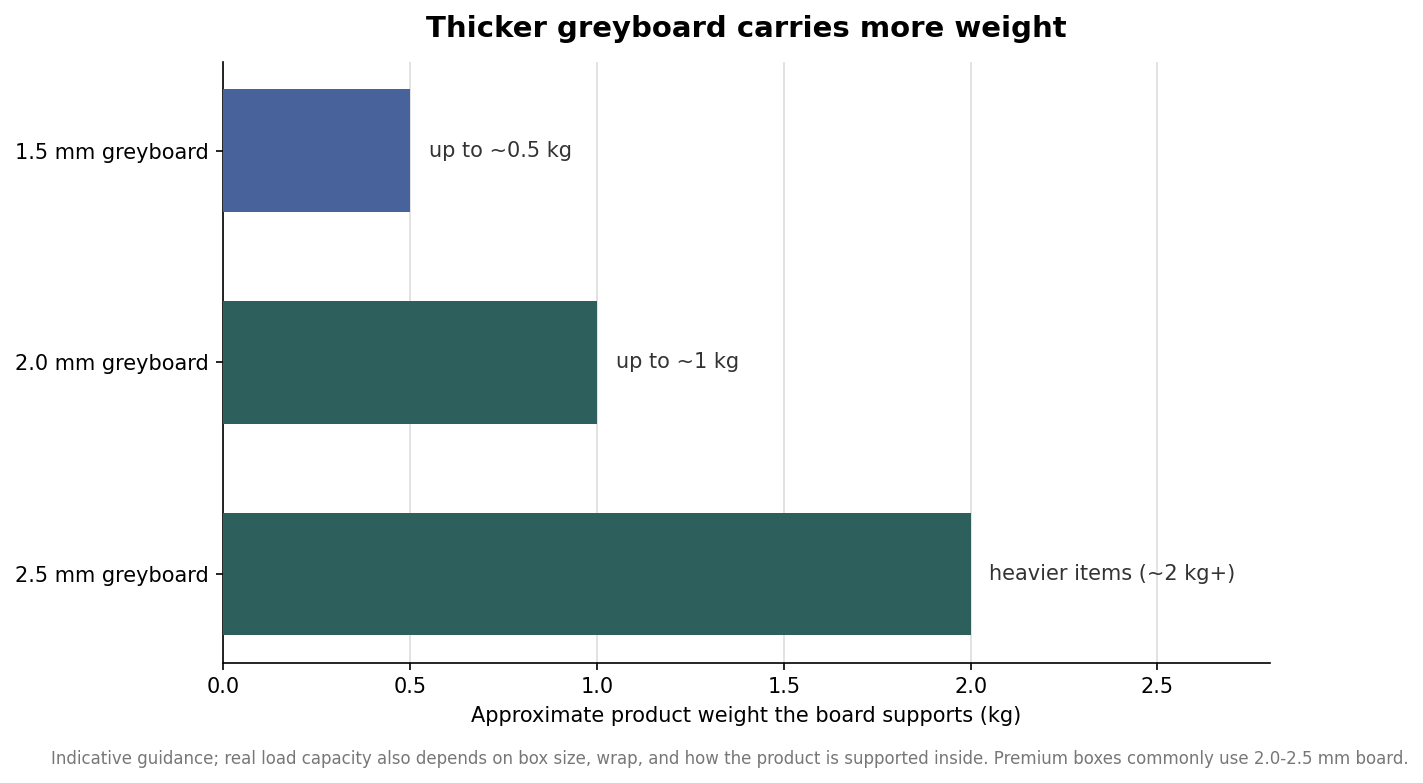
Match the board to the product weight and the handling it will get. Underspec the board and the box feels flimsy and the hinges fatigue faster; overspec it and you pay for material and folding complexity you do not need. When in doubt, ask a supplier to recommend a thickness for your exact product weight and dimensions rather than guessing.
What folding flat actually saves
The economics are the reason collapsible boxes exist. Because flat boxes stack densely, one commonly cited figure is fitting four to five times as many units into the same shipping container, which pushes freight costs down substantially and cuts the warehouse space you rent to hold inventory. A published worked example for a 3,000-unit order of medium boxes captures the shape of it: freight falling from roughly $3,600 to about $950, and six months of pallet storage dropping from around $1,080 to a little over $200, because the flat units needed a fraction of the pallets.
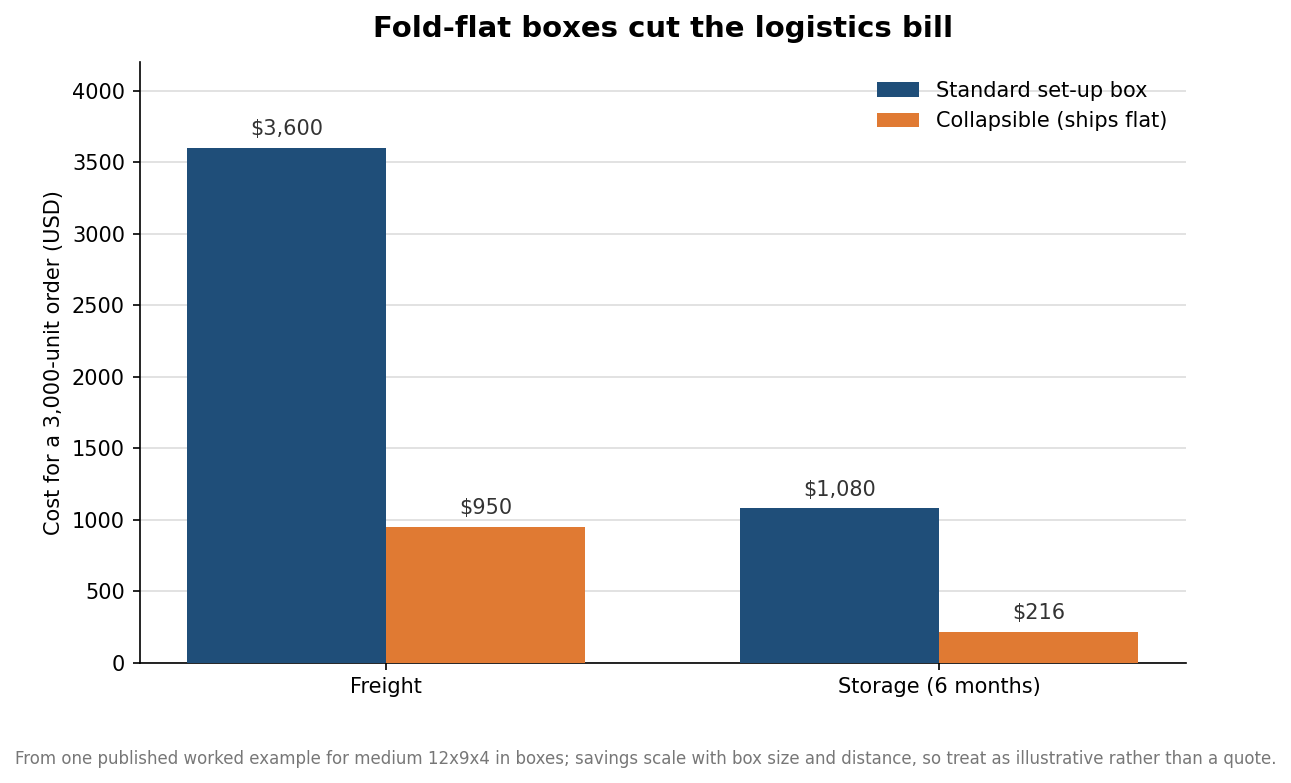
Treat those numbers as illustrative rather than a quote, because the savings scale with how bulky your box is and how far it ships. A large, deep box that traps a lot of empty volume benefits enormously from folding flat; a small, shallow box that already stacks reasonably well benefits less. The honest way to evaluate it is to price the same design both ways, including freight and a realistic estimate of storage, and compare the totals rather than just the per-box production price.
Where the magnet fits
Magnets are what let a folded box snap into a rigid shape and stay closed without tape or tabs. Small neodymium disc magnets are the common choice because they are compact and strong, producing that crisp closing pull; softer ferrite magnets give a gentler close and are sometimes used where a subtle feel is wanted. The magnets are set into routed cavities in the board and sealed under the interior lining, so they are completely hidden and cannot be felt through the wrap. Placement along the mating edges of the lid and body is what aligns the box as it closes. For collapsible designs, the same magnets often do double duty, holding the walls square once the box is erected.
When collapsible is worth it, and when it is not
Collapsible construction is not free. The V-groove cutting and added magnets typically raise the unit production cost by roughly 10 to 15 percent over a plain set-up box, and because the tooling is more involved, minimum order quantities commonly sit in the 500 to 1,000 unit range per design. There is also a small labor cost on your end, since someone has to pop each box into shape, on the order of 15 to 20 seconds per unit by hand, unless you build that into a pack-out line. In the worked example above, the higher production cost was more than offset by freight and storage savings, landing the collapsible option a bit cheaper per box overall, but that math depends entirely on box size and volume.
The practical decision rule is straightforward. If you ship large or deep rigid boxes, hold meaningful inventory, or move product across long distances, folding flat usually pays for itself and the magnetic closure is a genuine upgrade in feel. If your boxes are small, your quantities tiny, or your customers assemble nothing themselves and you cannot spare pack-out labor, a traditional set-up box may still be the simpler call. Either way, ask for a physical sample of the exact board and magnet before committing, because the difference between a collapsible box that feels premium and one that feels cheap comes down to details you can only judge in the hand.
Fold-flat magnetic rigid boxes are one of the few packaging upgrades that can improve both the unboxing moment and the logistics line at once. Spec the board to your product, price the design with freight and storage included, and the choice between set-up and collapsible stops being a matter of taste and becomes a number you can actually compare.
Leave a Reply